Uncover the Mystery Behind This Ingenious Brass Invention!

September 14, 2024

Source: Reddit
Do you still recall the time when products in our environment were designed to be durable and long lasting? From the robustness of your dad’s tools to the detail which was put into the making of even the most insignificant items, there was a certain quality of workmanship of the good old days that has a certain charm to it. The sounds I can still hear in my head are the noise of the machines in my grandfather’s workshop, the sound of metal and wood being cut and the sound of the brass tools. He had one of the most valuable treasures: a brass stencil, a simple tool that still bears the stories engraved on metal plates and wood
On the surface, a brass number template could be considered as a rather archaic tool, nonetheless, if one takes a closer look, it proves to be an important element in the process of design, engineering and even in the way we communicate. This brass engraving tool was not just a stencil which could be used to etch the design on the surface of the material: it was the only way to achieve accuracy on a level that would have been unimaginable in the age of automation. Think about having to generate serial numbers or labels for dozens of parts or even for hundreds of them. It was a simple tool which was instrumental in helping the craftsmen to come up with equally spaced and neat digits that they could not have been able to achieve through hand drawing. This was particularly applied along side the Pantograph-style engravers-a complex which was also another invention from the past that helped in making the work of engravers and machinists easier.
Pantograph engraving, in case you are not familiar with the concept, is a process whereby the user draws a design, and a mechanical arm draws the same design on a surface while replicating the user’s movements. If you are to cut numbers on metal, wood or plastic for instance to label products, equipment or even trophies, a brass number template like the one we have found would be ideal. This was not just a question of looks either. Such numbers could state the degree of precision needed for machine components and thus guarantee that a part produced in one city would be compatible with a machine assembled in another city.
And while today we have the advanced technologies of digital printing and laser engraving where it is a piece of cake to create uniform number or letters, the brass stencil is a reflection of the time when such accuracy had to be acquired through countless hours of training. You can picture it lying in workshops in the middle of the twentieth century when artisans used these tools to put their signature—literally. It was not so much about solving mathematical problems as about putting people’s intelligence into each and every project.
However, what adds more value to these tools is their resemblance of the culture of the period in which they were developed. There was an effort to standardize, to be accurate, and to reproduce the process as many times as needed. Factories, industries and even small workshops required producing a high number of labelled products and having a reliable tool such as a Pantograph with a brass stencil was a blessing. This is quite typical for the period in question, which characterized by the shift towards globalization, standardization, mass production, etc., when the products and their components required conformity to some certain standards regardless of their origin or application.
Nonetheless, there was creativity in the process because people needed things to be done quickly. They were beautifully made from brass most of the time and their mechanisms were smooth for use as they would surely last for many years. Today, possessing one in your hand allows you to have a sneak peek into that culture – a culture in which artisans would take their time to make each and every single component as flawless as possible and tools were not disposed of after their usefulness but rather they were handed down through generations.
However, there is always something liberating in the process of looking back at how tools like this helped form this world. They make us realize how important it is to have pride in what we do, to build things that will stand the test of time and the innovation that goes into the construction of even the simplest of objects. In the culture of the today’s society where everything is fast-paced and throwaway, one is likely to overlook the importance of things like the brass engraving stencil.
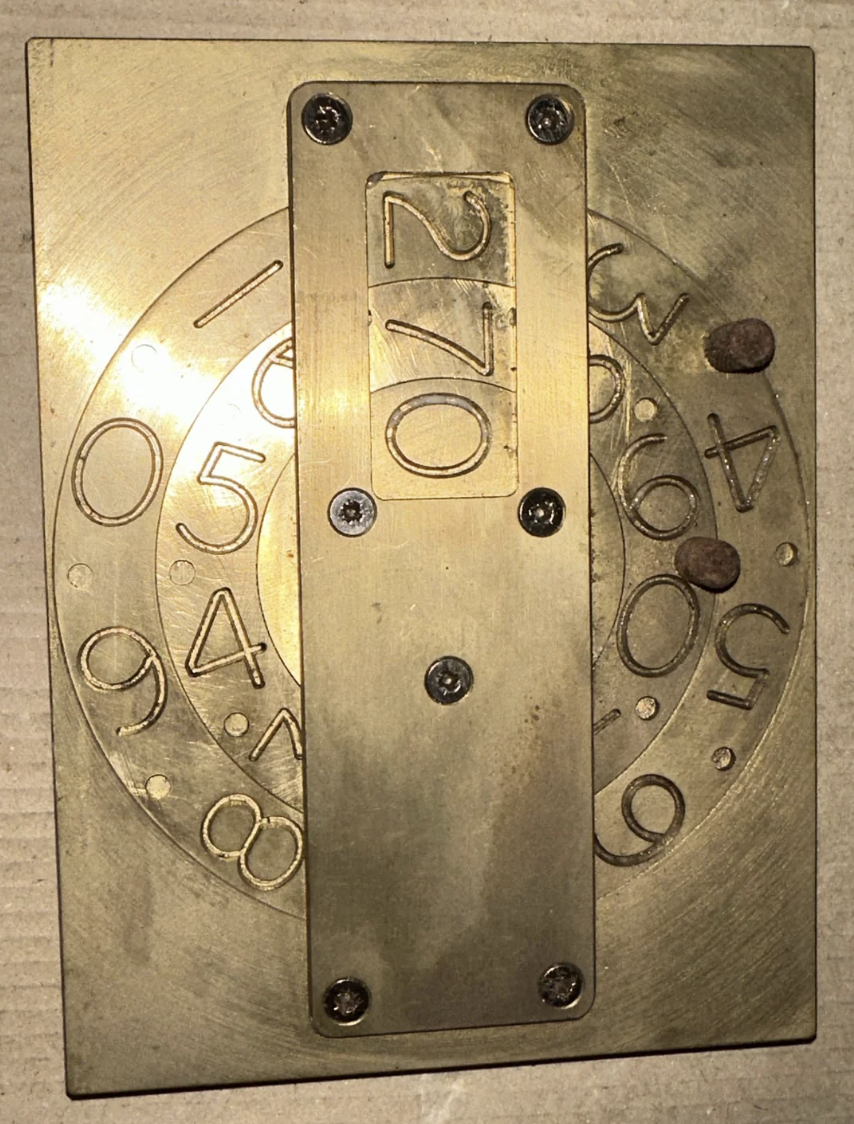
Looking at such gadgets in the context of today’s technological advancement, it is quite inspiring to see them as part of the craftsmanship history. The brass engraving stencil, with its thousand numbering possibilities, went about its work in silence; placing each highly separated digit in its due place. And in doing so, it not only influenced the items that were around us, but also the time in which we lived.