This Vintage Wooden Instrument Changed the Course of Engineering History—Here’s How

May 8, 2024
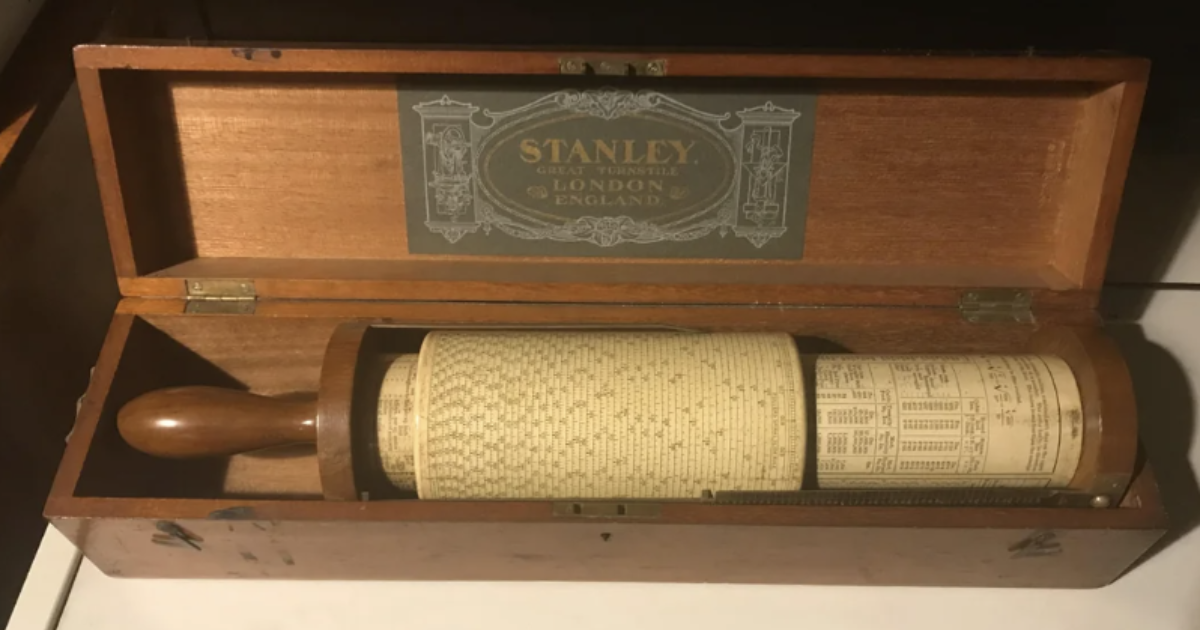
Source: Reddit
Ah, the Fuller’s Spiral Cylindrical Slide Rule—a relic that evokes the nostalgia of a time when craftsmanship, engineering, and ingenuity danced together in a singular mechanical marvel. This historical beauty was not just an instrument; it was a cornerstone of engineering precision in the late 19th and early 20th centuries. To many, this wooden cylinder encased in mahogany with a spiral scale may seem like a curious antique, but for engineers of the past, it was a trusted companion in their calculations.
Picture this: you’re an engineer in Victorian England, surrounded by grand steam locomotives and the beginnings of electric lighting. In the absence of modern computing power, you rely on instruments like the Fuller’s Spiral Slide Rule to navigate the intricate math required for your designs. You carefully rotate the cylinder, aligning the brass markers to uncover the right calculations among the countless logarithmic spirals. With each twist and slide, you solve problems that shape bridges, buildings, and a world stepping into a new industrial age.

The slide rule was more than just a tool—it was a gateway to scientific progress. With a nearly 42-foot-long logarithmic scale condensed into this wooden cylinder, George Fuller’s invention was a marvel of compact precision. Students and professionals alike would carry it in its elegant wooden box, marked proudly by its maker, Stanley, as if to remind them of its promise of accuracy.
Its tables, meticulously inscribed on the inner cylinder, were the universal constants of an engineer’s universe: from decimal equivalents and unit conversions to sine tables and material properties. In every marking, a story of craftsmanship is revealed—a bridge between empirical learning and practical application.
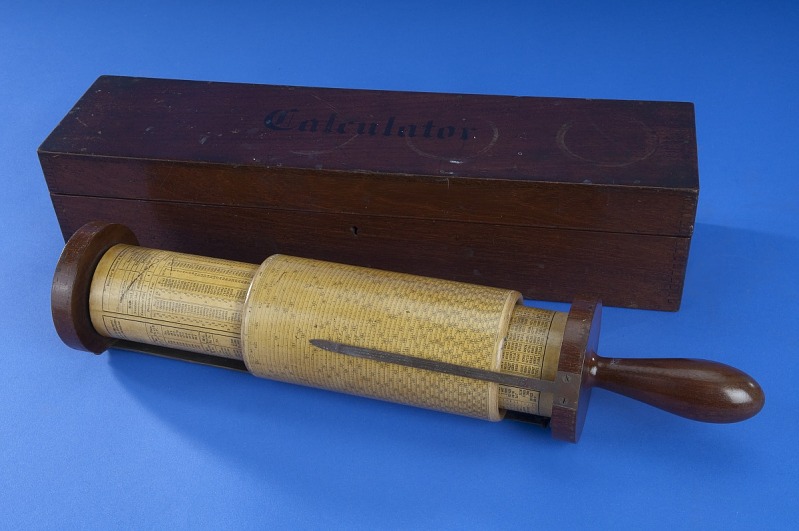
The Stanley company, whose name is etched onto this device, was renowned for quality craftsmanship, and this slide rule embodied the era’s technological optimism. Engineers of that time would have been familiar with Schmidt’s supply shop, a Washington D.C. hub for drafting materials where this slide rule may have found its first proud owner.
Though today we carry pocket-sized computers capable of unimaginable calculations, the Fuller’s Spiral Slide Rule remains a testament to the intellectual curiosity and innovative spirit of its time. Imagine yourself as a budding engineer, the sense of mastery as you finally conquer a problem after carefully working the logarithmic spirals. This tool wasn’t just an artifact; it was a beacon for those navigating the unknown waters of a rapidly changing technological world.

As you look upon this ingenious instrument, consider sharing memories or stories about other relics of a bygone era that held special meaning for you or your family. Every piece of history, whether a tool or tradition, holds a fragment of the spirit of its age, just like this slide rule.