The Surprising Reason This Window Marking Exists

March 24, 2026

source: Reddit
Most travelers seldom recognize some of the lesser details about an aircraft window. Travelers will generally look outside the window, examine the wing and wait until take-off.
There are, however, reference points or marks on some windows which provide a functional use.
One of those components is the Aircraft Inspection Window Indicator.
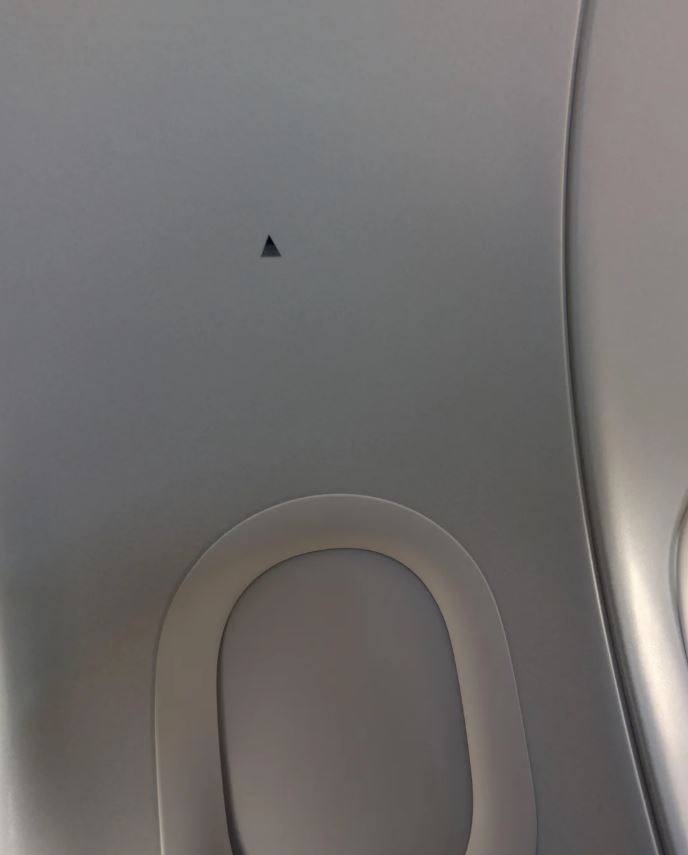
Upon initial examination, the Aircraft Inspection Window Indicator would appear to be nothing more than a sticker or a drawn shape on the window.
However, the Aircraft Inspection Window Indicator is an integral part of the rapid communication process between crew members on board the aircraft.
Given the constraints of time, the crew doesn’t wish to confuse the crew members about where to visually inspect (look) or what to visually inspect.
What the Aircraft Inspection Window Indicator Offers
The Aircraft Inspection Window Indicator offers cabin staff the proper viewpoint. From that viewpoint, the staff members can achieve the best possible viewpoint for the purpose of visually inspecting the exterior of the aircraft.
Depending upon the specific circumstances of the flight, the flight crew may ask the cabin staff to visually inspect the engines, a portion of the wing, or other portions of the aircraft. The flight crew require a second pair of eyes to help identify any potential problems. In addition, the flight crew also require that the second pair of eyes are in the optimal position.
In terms of this, the Aircraft Inspection Window Indicator can be beneficial. Without the Aircraft Inspection Window Indicator, a cabin staff member could potentially look through the wrong window and therefore receive only a partial view of the problem. Even a few seconds of uncertainty can lead to delays in flight. Therefore, a clear indicator eliminates the need to assume.
Why the Design Is Important
The design of the Aircraft Inspection Window Indicator is for functionality, not aesthetics. The Aircraft Inspection Window Indicator clearly indicates to the cabin staff, “Use this window”. Although this seems obvious, in the aviation industry, many of the smallest indicators support much larger safety procedures.
Because the visual indicators relied on by airlines and aircraft manufacturers, these indicators aid the crew in responding quickly and uniformly. The Aircraft Inspection Window Indicator is just one example of how aircraft are built with multiple purposes.
The Window Can Help with Visual Inspection of More Than Just the Engines
In addition, there is often a secondary useful feature near the inspection window. Many aircraft are provided with a visual reference device that helps the cabin staff determine the flap angle. Like the Aircraft Inspection Window Indicator, this detail is often overlooked by most of the passengers.
However, being able to determine the flap angle is important when the flight crew asks the cabin staff to visually confirm the flap angle.
Flaps are mounted on the wings of the aircraft and extend downward from the wings to provide increased lift and improved performance at lower speeds during the different phases of flight, including takeoff and landing. Determining the exact flap angle visually is difficult from inside the cabin.
Thus, having a flap position reference device near the inspection window can be helpful. The reference allows the crew to visually confirm the flap position seen by comparing the flap position against a known reference point.
Utilizing the Flap Position Reference by Cabin Staff
In summary, the Aircraft Inspection Window Indicator performs one function, while the flap reference (if present) performs another. The Aircraft Inspection Window Indicator directs the crew to the proper inspection location. The flap reference permits the crew to verify what they visually see.
Both references enhance communication between the cabin and cockpit. When the pilots need a quick visual assessment, the cabin crew is able to go to the proper window and give an accurate report.
As mentioned previously, the simplicity of this design demonstrates how successful safety designs operate. Successful safety designs are simple, easy to understand and utilize in stressful conditions.
An Excellent Example of Useful Aviation Design
This type of arrangement exemplifies how the aviation industry works. Although modern aircraft include sophisticated computer systems, sensors, and warning devices, visual inspections are still needed.
While pilots have instrumentation in front of them, they still wish to get a direct look at something else. Therefore, the cabin crew is able to provide this visual assistance because of their proximity to the cabin.

Cabin Crew Members Serve More Than One Function
Many people incorrectly believe that the sole responsibility of the cabin crew is to provide service to passengers. The reality is that cabin crew members are trained safety professionals who act on irregular events, carry out pilot instructions, and monitor the cabin and its environs for any hazards.
One example of how the cabin crew members operate as part of the total safety system of the aircraft is the Aircraft Inspection Window Indicator.
Feature Most Passengers Will Not Notice Unless Pointed Out
Another factor associated with this particular feature is that most passengers will likely overlook the importance of this feature unless someone explicitly calls their attention to it. The Aircraft Inspection Window Indicator becomes part of the surrounding area of the cabin and appears to be nothing more than another small identification label or marking.
However, the Aircraft Inspection Window Indicator is indeed functional. This is a typical trait of the aviation industry where the most significant features are the ones that will probably go unnoticed.
Aviation Enthusiasts: Features Such as This Offer Insights into the Functional Design of Commercial Jet Aircraft
Aviation enthusiasts are able to appreciate how each of the markings, arrows, triangles and lines on the commercial jet aircraft is for a specific purpose. Some of these features are for the benefit of passengers. Other features are for directing maintenance staff. Others, like the Aircraft Inspection Window Indicator, assist the operating crew to do their job more efficiently.
Small Details Matter When Traveling by Airplane
To the average traveler, this is a reminder that a commercial airliner includes many components that were deliberately designed. Every component of the aircraft, including the seating, windows, overhead containers, emergency information cards and even a small triangle-shaped marker, had a deliberate reason for inclusion.
None of the elements of the aircraft were placed there arbitrarily. Instead, they represent a system developed to create order, clarity and safety.